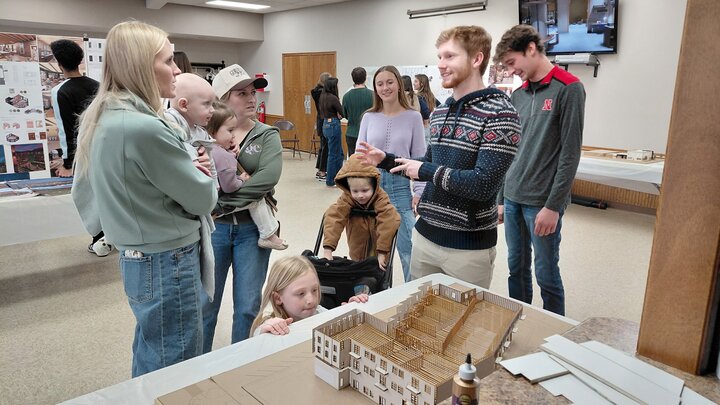
For years, residents and local leaders in Axtell have shared a common challenge faced by many small rural communities: how to reinvest in their downtown, strengthen Main Street and create amenities that support daily life while encouraging long-term growth. Limited access to planning and design resources made it difficult to turn those ideas into a shared, actionable vision.
That need sparked a new partnership this fall between the Village of Axtell and the University of Nebraska–Lincoln College of Architecture’s ASSIST program, a community-focused design studio dedicated to helping Nebraska towns frame challenges and explore opportunities through design.
During this semester’s Axtell Community Design Day, held in Axtell, an interdisciplinary team of faculty and fourth-year, Collaborate Studio students in architecture, interior design and landscape architecture worked directly with residents, property owners and community stakeholders to envision strategies for downtown revitalization. The studio is led by faculty members Nate Bicak and Steven Hardy, whose ASSIST program has supported rural communities across Nebraska for more than six years.
“This project started by listening,” said Hardy. “Communities like Axtell know what they need, but often don’t have access to the tools or time to explore ideas at a larger scale. Our role is to help create space for conversation and translate those priorities into design possibilities they can carry forward.”
Throughout that day and over the course of the semester, students engaged residents through design games, informal conversations, site walks and interactive visuals. That input directly shaped proposals focused on strengthening their Main Street identity, introducing a community restaurant and bar, exploring mixed-use housing with childcare and retail, creating a community event center and enhancing outdoor gathering and social spaces.
“The ASSIST studio works as an incubator,” said Bicak. “By involving residents at every step, students learn participatory design while communities gain ideas grounded in real needs, realistic budgets and local values.”
Local stakeholder and Main Street property owner Jon Freeland said the process itself was as impactful as the design outcomes.
“What I enjoyed most was the journey,” Freeland said. “From the first phone call to the students coming out and meeting with our community, seeing what they heard, how they understood it and how they built out a shared vision was exciting. Having architects, landscape architects and interior designers thoughtfully examine what Main Street could become brought new perspectives and ideas that sparked meaningful conversations about what’s possible in a small town.”
Freeland noted particular excitement around concepts for a multifunctional Main Street development that could include retail, childcare, residential options and a community gathering space, as well as a restaurant proposal designed to be both functional and achievable in the near term.
“The town needs a restaurant,” he said. “The students came up with an option that feels doable and flexible, something I could realistically take to the next step with investors.”
Students emphasized the responsibility that comes with working in a real community. Architecture student Cheyenne Storms said the experience mirrored what she might find in professional practice.
“Working with actual stakeholders was exactly what I hoped for in an architecture education,” Storms said. “We had to explain our ideas clearly to people outside the design industry and stay realistic about cost and implementation. Knowing our work could influence the town, even just by generating excitement, made us more thoughtful designers.”
Storms’ team proposed an adaptive reuse concept for Axtell’s only two-story commercial building, envisioning it as a community hub with short-term lodging, gallery space, café, lounge and creator space that builds on the town’s growing farmers market and entrepreneurial spirit.
“Small towns have a unique ability to build community internally,” Storms said. “Our project draws on that and encourages Axtell’s opportunistic spirit.”
The Axtell project is expected to continue through future semesters, with new studios and disciplines building on this initial vision and advancing ideas into additional phases of exploration.
“If rural Nebraska wins, the university wins,” Freeland said. “Programs like ASSIST bring the academic side and the rural side together. For towns like Axtell, just seeing what could be is a huge step forward.”
The ASSIST program has previously partnered with communities including Kimball, Valentine and Wayne, Nebraska, using a similar methodology of immersive engagement, community-driven visioning and design exploration to support economic development and long-term resilience.
Through partnerships such as Axtell, the College of Architecture continues its land-grant mission, working alongside communities of all sizes to plan, design and grow in ways that foster connection, vitality and resilience.
About ASSIST
ASSIST is a community-based design studio within the University of Nebraska–Lincoln College of Architecture that partners with communities across the state to help frame challenges, explore opportunities and envision design-driven solutions for growth and revitalization.