
-
 Stop Design
 -
 Stop Design
 -
 Stop Design
 -
 Stop Design
 -
 Stop Design
 -
 Stop Design
 -
 Stop Design
 -
 Stop Design
 -
 Stop Design
 -
 Stop Design
 -
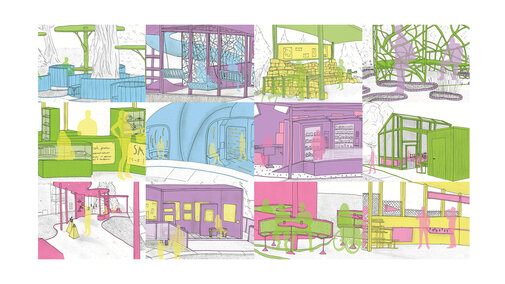 Stop Design
Team:
Student: Elizabeth Nielsen
Faculty: Dr. Sharon Kuska
ARCH Thesis / 2025
Public spaces are the foundation of our social health and wellbeing, but are often designed without considering the needs of the public, creating spaces that people do not feel encouraged to use. Just as public space design as a whole often falls short of serving the public, the same can be said for a subset of public space design, public transit stops. While they are public spaces created for the purpose of waiting, their design rarely reflects this.
Well-designed public transit stops are capable of both maintaining existing ridership and drawing in new riders. Most commonly, this sort of design occurs at the scale of the amenity (the industrial design scale), in which amenities are deployed at stops to mitigate perceived flaws in public transit. Design strategies can also be leveraged at the city planning scale for the same purposes. While both scales can be effective if leveraged correctly, this is rarely the case. Instead of considering the needs of the community surrounding each stop, stops are repeated throughout cities with little to no nuance. This approach results in public transit stops that are inadequate to the communities they are intended to serve, failing to accommodate existing riders or serve a purpose to non-riders. Perceptions of public transit are negative and ridership declines. These spaces are not for the public.
Rather than continuing a failing approach to stop design, the thesis proposes an exploration of public transit stop design at the scale of architecture. At this scale, one which has been neglected to this point, the site-specificity and community-driven principles fundamental to architecture may be capable of addressing the flaws brought about by the industrial design and city planning approaches to public transit design. The thesis suggests that, at this scale of design, public transit stops should be individually designed based on their surrounding context and user needs in order to increase the functionality and importance of the bus stop for a community of riders and non-riders.